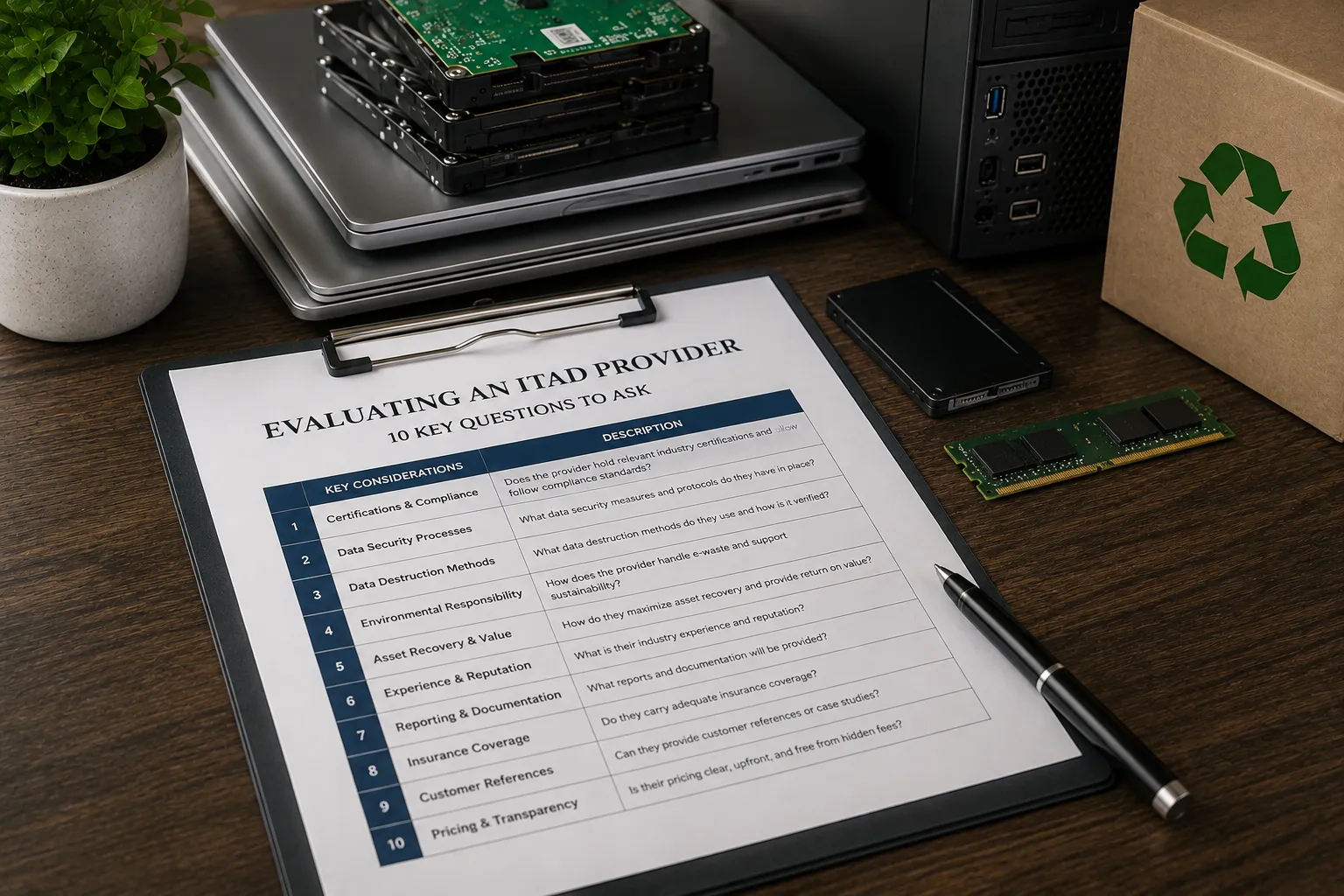
Choosing the right IT Asset Disposition (ITAD) provider is an important decision for any organization managing retired technology.
Every company eventually reaches a point where computers, laptops, servers, storage devices, and other electronic assets need to be replaced. Whether due to technology upgrades, equipment refresh cycles, office relocation, or business expansion, organizations must determine what happens to their old IT equipment once it is removed from active use.
At first glance, IT asset disposal may seem simple:
- Collect old equipment
- Remove data
- Recycle or dispose of the assets
However, professional ITAD services involve much more than simply removing unwanted devices.
Retired IT equipment may still contain:
- Customer information
- Employee records
- Financial documents
- Internal communications
- Business strategies
- Intellectual property
- Stored credentials
At the same time, these assets may still have value through:
- Refurbishment
- Redeployment
- Resale
- Responsible recycling
A qualified ITAD provider helps organizations manage retired technology securely while maximizing asset value and reducing environmental impact.
The wrong ITAD partner can create serious risks, including:
- Data breaches
- Loss of valuable equipment
- Lack of documentation
- Improper electronic waste handling
- Compliance concerns
For this reason, organizations should carefully evaluate potential ITAD partners before making a decision.
This guide explains the 10 most important questions to ask before hiring an ITAD provider and what businesses should consider when selecting a trusted technology disposition partner.
What Is an ITAD Provider?
An IT Asset Disposition (ITAD) provider specializes in managing technology assets at the end of their useful lifecycle.
The purpose of ITAD is not simply to remove old equipment from an organization.
A professional ITAD process helps businesses securely manage the complete journey of retired technology, from collection through final disposition.
Typical ITAD services may include:
- Secure IT equipment collection
- Reverse logistics
- Asset inventory management
- Data wiping
- Data sanitization verification
- Assured Destruction
- Equipment refurbishment
- Asset resale
- Electronic waste recycling
- Reporting and documentation
A strong ITAD program balances three important goals:
1. Protect Sensitive Information
Retired devices may contain confidential business and personal information.
Proper data handling ensures information is securely removed before equipment is reused, recycled, or destroyed.
2. Recover Asset Value
Many retired devices still have useful life remaining.
A professional ITAD provider evaluates whether equipment can be:
- Reused internally
- Refurbished
- Resold
- Recycled for material recovery
3. Support Responsible Disposal
Technology contains valuable materials that should be managed responsibly.
Proper ITAD helps organizations reduce electronic waste while supporting sustainable business practices.
Why Choosing the Right ITAD Provider Matters
Organizations often focus heavily on protecting data while devices are actively being used.
They invest in:
- Cybersecurity systems
- Access controls
- Encryption
- Monitoring tools
- Backup solutions
However, information security does not end when equipment reaches the end of its operational life.
Old laptops, servers, hard drives, and storage devices may still contain sensitive information even after they leave employee workspaces.
A reliable ITAD provider helps organizations maintain control over these assets until their final outcome.
Risks of Choosing the Wrong ITAD Provider
Selecting an inexperienced or unreliable provider can expose organizations to several risks.
Data Security Risks
Retired devices may contain recoverable information if they are not properly sanitized.
Examples include:
- Customer databases
- Employee records
- Company documents
- Email archives
- Confidential projects
Without proper data wiping or assured destruction processes, sensitive information may remain accessible.
Compliance Risks
Organizations may need to demonstrate that retired equipment was handled responsibly.
Without proper documentation, companies may struggle to prove:
- What assets were collected
- How data was removed
- Where equipment went
- What happened after processing
Financial Loss
Poor IT asset management can result in missed opportunities to recover value.
Equipment that could have been refurbished or resold may be unnecessarily discarded.
Environmental Risks
Improper disposal of electronic equipment contributes to electronic waste problems.
A responsible ITAD provider should prioritize:
- Reuse
- Refurbishment
- Resale
- Recycling
- Assured Destruction when required
What Makes a Good ITAD Provider?
A reliable ITAD partner should provide more than transportation and disposal.
Organizations should look for providers that offer:
Secure Data Management
Including:
- Professional data wiping
- Data verification
- Assured Destruction options
- Certificates and reports
Complete Asset Visibility
Including:
- Asset tracking
- Serial number recording
- Inventory reports
- Final disposition records
Value Recovery Opportunities
Including:
- Refurbishment
- Resale
- Redeployment
- Material recovery
Responsible Environmental Practices
Including:
- Proper recycling processes
- Electronic waste management
- Reduced landfill impact
- Sustainable asset handling
1. How Do You Handle Data Security and Data Destruction?
Data security should be the first consideration when selecting an ITAD provider.
Retired technology does not automatically become safe once it is removed from an employee's desk or disconnected from a company network.
Storage devices such as:
- Hard disk drives (HDDs)
- Solid-state drives (SSDs)
- Servers
- USB drives
- Backup media
- Mobile devices
may still contain sensitive information long after they are retired.
A professional ITAD provider should have clear procedures for protecting data throughout the entire asset lifecycle.
This includes:
- Secure data collection
- Data sanitization
- Verification processes
- Documentation
- Assured Destruction when required
Questions to Ask:
Before selecting an ITAD partner, organizations should ask:
- What data sanitization methods do you use?
- Do you provide certified data wiping services?
- How do you verify that data has been removed?
- Do you provide Certificates of Data Sanitization?
- How do you handle failed or damaged storage devices?
- When do you recommend Assured Destruction?
Why This Matters
Many organizations assume that deleting files, formatting drives, or performing factory resets permanently removes information.
However, these methods may not completely eliminate stored data.
Professional data wiping uses specialized processes designed to make information inaccessible before equipment is reused, refurbished, or resold.
For assets that cannot be securely wiped, or for information requiring a higher level of protection, Assured Destruction may be the appropriate solution.
This involves physically destroying the storage media so that data recovery becomes impractical or impossible.
The right method depends on:
- Data sensitivity
- Device condition
- Security requirements
- Business policies
A trustworthy ITAD provider should be able to explain when data wiping is appropriate and when Assured Destruction is necessary.
2. Do You Maintain Chain of Custody for All Assets?
Once retired equipment leaves an organization's facility, maintaining visibility becomes essential.
A professional ITAD process should include a documented chain of custody that tracks assets from collection until final disposition.
Chain of custody helps organizations understand:
- What equipment was collected
- Who handled the assets
- Where the equipment was processed
- What happened after processing
A Strong Chain of Custody Process Should Include:
Collection Records
Information such as:
- Collection date
- Location
- Asset quantity
- Responsible personnel
Asset Identification
Tracking details such as:
- Serial numbers
- Asset tags
- Device types
- Manufacturer information
Transportation Tracking
Organizations should know that equipment remains controlled while moving from their facility to the processing location.
Final Disposition Records
The organization should be able to confirm whether assets were:
- Redeployed
- Refurbished
- Resold
- Recycled
- Processed through Assured Destruction
Questions to Ask:
Organizations should ask:
- How do you track assets after collection?
- Are serial numbers recorded?
- Do you provide inventory reports?
- How do you prevent lost or misplaced equipment?
- Can you provide proof of final disposition?
Why This Matters
A company should never lose visibility once equipment leaves its premises.
A strong chain of custody process provides confidence that retired technology was handled properly from start to finish.
This is especially important for organizations managing:
- Customer information
- Employee records
- Financial data
- Confidential business information
Proper tracking also supports:
- Internal audits
- Compliance reviews
- Security investigations
- Corporate governance requirements
3. What Happens to Equipment After Collection?
Many organizations focus on removing old equipment but fail to ask what happens afterward.
A responsible ITAD provider should have a clear process for evaluating every asset after collection.
The goal should not be to immediately dispose of equipment.
Instead, each asset should be assessed to determine the most appropriate outcome.
Possible outcomes include:
- Redeployment
- Refurbishment
- Resale
- Recycling
- Assured Destruction
Questions to Ask:
Before choosing an ITAD provider, ask:
- Do you evaluate equipment before recycling?
- Do you test working devices?
- Can you recover value from reusable assets?
- What happens to equipment that cannot be reused?
- Do you prioritize reuse before recycling?
Why This Matters
Not every retired device is waste.
Many computers, laptops, servers, and networking devices still have useful life remaining.
A professional ITAD provider should help organizations maximize the value of retired technology by identifying opportunities for:
Reuse
Equipment may be redeployed within the organization.
Examples:
- Employee replacement devices
- Training equipment
- Backup systems
Refurbishment
Devices may be repaired, tested, and prepared for continued use.
Resale
Equipment with market value may be sold through approved channels.
Recycling
Devices that cannot be reused should be processed responsibly to recover valuable materials.
Assured Destruction
Certain assets may require permanent destruction due to:
- Failed storage media
- Highly confidential information
- Security requirements
A strong ITAD provider does not simply remove old equipment.
They help organizations make informed decisions about security, sustainability, and asset recovery.
4. Do You Offer Data Wiping and Assured Destruction Services?
Different types of retired IT equipment require different levels of data protection.
A professional ITAD provider should not use a single approach for every device. Instead, they should evaluate each asset based on:
- Data sensitivity
- Device condition
- Security requirements
- Business policies
- Future use potential
Some equipment may be suitable for secure data wiping, while other assets may require Assured Destruction.
Data Wiping
Data wiping is a secure software-based process that removes information from storage devices by overwriting existing data.
This method is commonly used when equipment may continue to have value through:
- Internal reuse
- Refurbishment
- Resale
- Redeployment
Examples include:
- Employee laptops being replaced during a refresh cycle
- Desktop computers being upgraded
- Servers being retired but still functional
A professional data wiping process should include:
- Identification of the device
- Secure sanitization procedure
- Verification of completion
- Documentation of results
Assured Destruction
For certain assets, physical destruction may be the most appropriate solution.
Assured Destruction involves permanently destroying data-bearing media to prevent information recovery.
This may apply to:
- Failed hard drives
- Damaged storage devices
- Highly confidential information
- Devices that cannot be securely wiped
Methods may include:
- Hard drive shredding
- Crushing
- Controlled physical destruction processes
The objective is to ensure that sensitive information cannot be recovered after disposal.
Questions to Ask:
When evaluating an ITAD provider, organizations should ask:
- Do you provide certified data wiping?
- What standards guide your sanitization process?
- Do you offer Assured Destruction services?
- When do you recommend physical destruction instead of wiping?
- Do you provide certificates after completion?
Why This Matters
A qualified ITAD provider should help organizations choose the right solution instead of automatically destroying every device.
A balanced approach protects information while preserving value where possible.
For example:
Functional laptop:
Data wiping → Testing → Refurbishment → Resale or redeployment
Failed storage device:
Secure handling → Assured Destruction → Responsible recycling
The correct decision depends on the circumstances of each asset.
5. How Do You Handle Asset Tracking and Reporting?
Documentation is one of the most important parts of professional IT Asset Disposition services.
Organizations should have clear records showing what happened to their retired technology.
A reliable ITAD provider should provide visibility throughout the entire process.
Important Documentation May Include:
Asset Disposition Reports
These reports may include:
- Equipment processed
- Asset identification details
- Quantity of devices
- Final disposition outcome
Examples:
- Reused
- Refurbished
- Resold
- Recycled
- Destroyed
Data Sanitization Certificates
These documents confirm:
- Which devices were sanitized
- The method used
- Completion status
- Processing date
Certificates of Destruction
For assets processed through Assured Destruction, documentation may confirm:
- Destroyed equipment
- Destruction method
- Date completed
- Processing details
Questions to Ask:
Organizations should ask:
- What reports do you provide?
- Can reports include serial numbers?
- Can we track final asset outcomes?
- Do you provide certificates for completed services?
- How long are processing records maintained?
Why This Matters
Documentation provides evidence that retired assets were handled responsibly.
It supports:
- Internal audits
- Compliance reviews
- Security assessments
- Sustainability reporting
- Corporate governance
A company should be able to demonstrate not only that equipment was removed, but also what happened afterward.
6. What Are Your Recycling and Environmental Practices?
A responsible ITAD provider should consider the environmental impact of retired technology.
Electronic equipment contains valuable materials that can be recovered, including:
- Metals
- Plastics
- Electronic components
- Circuit boards
However, improper handling of electronic waste can create environmental concerns.
A professional ITAD process should ensure that equipment is processed through responsible recycling channels.
Questions to Ask:
Organizations should ask:
- What happens to equipment that cannot be reused?
- How are electronic components processed?
- Do you prioritize reuse before recycling?
- How are recovered materials handled?
- Can you provide environmental reporting?
The Importance of a Circular Economy Approach
Modern ITAD is moving away from a simple disposal model.
Instead, organizations are adopting a circular approach that keeps technology resources in use for as long as possible.
A responsible hierarchy is:
- Reuse equipment when possible
- Refurbish devices that still have useful life
- Resell assets that retain market value
- Recover materials through recycling
- Use Assured Destruction when required
This approach allows organizations to balance:
- Data security
- Financial recovery
- Sustainability goals
Why Environmental Responsibility Matters
Companies are increasingly expected to demonstrate responsible technology management.
A strong ITAD program can support:
- ESG initiatives
- Sustainability reporting
- Corporate responsibility goals
- Reduced electronic waste
Choosing an ITAD provider with responsible recycling practices helps organizations ensure that retired technology continues to create value instead of becoming unnecessary waste.
7. Can You Support Refurbishment and Asset Recovery?
A professional ITAD provider should look beyond disposal.
Many organizations make the mistake of viewing retired technology as waste, when in reality, many devices still have useful value.
Laptops, desktops, servers, and networking equipment may still be suitable for:
- Internal redeployment
- Refurbishment
- Resale
- Parts recovery
A responsible ITAD partner should evaluate each asset carefully before determining its final outcome.
Questions to Ask:
Organizations should ask:
- Do you refurbish retired equipment?
- Can you evaluate the remaining value of assets?
- Do you support resale programs?
- Can equipment be redeployed internally?
- How do you determine whether an asset should be reused or recycled?
Why This Matters
Asset recovery allows organizations to gain more value from retired technology while reducing unnecessary waste.
Benefits may include:
Financial Recovery
Reusable equipment may generate value through:
- Resale programs
- Refurbishment
- Secondary markets
Extended Equipment Lifecycles
Devices that are no longer suitable for one purpose may still be useful elsewhere.
Examples include:
- Employee replacement equipment
- Training devices
- Backup systems
- Donation programs
Reduced Environmental Impact
Extending the life of technology reduces the demand for new manufacturing and helps minimize electronic waste.
A strong ITAD provider helps organizations find the right balance between security, sustainability, and financial recovery.
8. Do You Have Experience With Organizations Similar to Ours?
ITAD requirements can vary significantly depending on an organization's size, industry, and regulatory responsibilities.
A provider experienced with similar organizations will better understand the challenges involved.
For example, a financial institution may have different requirements compared with:
- A manufacturing company
- A healthcare organization
- A BPO company
- A government organization
- A large enterprise
Questions to Ask:
Organizations should ask:
- Have you worked with companies in our industry?
- Can you manage our expected equipment volume?
- Do you understand our security requirements?
- Can you support multiple locations?
- Can you provide examples of similar projects?
Industries That Commonly Require Strong ITAD Processes
Financial Services
Banks and financial organizations manage highly sensitive information, including:
- Customer records
- Account information
- Transaction data
These organizations often require strong security controls and detailed documentation.
Healthcare Organizations
Healthcare providers manage sensitive personal information and require careful handling of devices containing patient-related data.
Business Process Outsourcing (BPO)
BPO companies often manage large volumes of client information and frequently replace significant numbers of employee devices.
They may require:
- Secure collection
- Large-scale data sanitization
- Detailed reporting
Large Enterprises
Large organizations often need ITAD providers capable of handling:
- Multiple locations
- Large equipment volumes
- Complex asset tracking requirements
Why Industry Experience Matters
An experienced ITAD provider understands that every organization has different priorities.
Some companies may focus on:
- Maximum data security
Others may prioritize:
- Asset recovery
- Sustainability goals
- Large-scale processing capability
The right provider should adapt its services to the organization's specific needs.
9. What Certifications, Standards, or Processes Do You Follow?
Standards and certifications can help demonstrate that an ITAD provider follows structured and repeatable processes.
Organizations should understand what frameworks guide the provider's operations.
Commonly referenced standards include:
NIST Special Publication 800-88 – Guidelines for Media Sanitization
This provides guidance on secure media sanitization methods and helps organizations understand appropriate approaches for protecting data on storage devices.
ISO/IEC 27001 – Information Security Management Systems
This standard focuses on establishing structured information security practices.
ISO/IEC 21964 – Destruction of Data Carriers
This provides guidance related to the secure destruction of data-bearing media.
Questions to Ask:
Organizations should ask:
- What standards guide your ITAD processes?
- Do you follow recognized data security practices?
- How do you ensure consistent service quality?
- Do you provide documentation showing completed processing?
Why This Matters
Standards help demonstrate that processes are:
- Structured
- Repeatable
- Documented
- Accountable
While certifications alone do not guarantee quality, they can provide additional confidence when evaluating potential ITAD partners.
10. Can You Scale With Our Future Needs?
Technology requirements continue to change.
Organizations may require ITAD support for:
- Annual laptop refresh programs
- Office relocations
- Data center closures
- Mergers and acquisitions
- Large equipment retirement projects
A provider that meets today's needs should also be capable of supporting future requirements.
Questions to Ask:
Organizations should ask:
- Can you handle large equipment volumes?
- Do you support multiple locations?
- Can you provide scheduled collections?
- Can you manage recurring IT refresh projects?
- Can your reporting scale with our requirements?
Why This Matters
ITAD should not be viewed as a one-time disposal transaction.
The strongest partnerships develop over time.
A scalable ITAD provider helps organizations maintain consistent processes for:
- Asset management
- Data security
- Reporting
- Sustainability initiatives
As businesses continue upgrading technology, having a reliable ITAD partner simplifies future asset transitions.
Additional Questions Procurement Teams Should Consider
Beyond technical capabilities, procurement teams should evaluate several additional areas before selecting an ITAD provider.
Pricing Structure
Organizations should understand:
- How services are priced
- Whether additional fees apply
- How asset recovery value is handled
- What services are included
The lowest price does not always represent the best overall value.
Security, transparency, and service quality should also be considered.
Service Agreements
Before signing an agreement, organizations should understand:
- Expected timelines
- Responsibilities of each party
- Collection procedures
- Reporting requirements
- Issue resolution processes
Clear agreements help prevent misunderstandings later.
Communication and Support
A strong ITAD relationship requires reliable communication.
Organizations should ask:
- Who manages our account?
- How are updates provided?
- How quickly are questions addressed?
- Who should we contact if issues occur?
A responsive provider creates confidence throughout the entire IT asset disposition process.
Warning Signs When Choosing an ITAD Provider
Selecting an ITAD provider is an important decision because the provider will be responsible for managing company assets that may contain sensitive information.
While many providers offer similar services, organizations should carefully evaluate how each provider operates.
Certain warning signs may indicate that a provider does not have the necessary security, transparency, or processing capabilities.
Warning Sign 1: They Cannot Clearly Explain Their Process
A professional ITAD provider should be able to explain exactly what happens after equipment is collected.
Organizations should understand:
- Where assets are processed
- How data is removed
- How equipment is tracked
- What happens to reusable devices
- How recycling is handled
If a provider cannot clearly explain its process, organizations may have limited visibility after equipment leaves their facility.
Warning Sign 2: They Do Not Provide Documentation
Documentation is a critical part of responsible IT asset disposition.
A reliable provider should be able to provide records such as:
- Asset disposition reports
- Data sanitization certificates
- Certificates of destruction
- Processing summaries
Without proper documentation, organizations may struggle to prove that equipment and data were handled responsibly.
Warning Sign 3: They Focus Only on Disposal
A strong ITAD provider should not treat every retired device as waste.
Professional ITAD services should consider:
- Data security
- Asset recovery
- Refurbishment opportunities
- Sustainability goals
- Responsible recycling
The best approach is not always immediate destruction.
Instead, each asset should be evaluated to determine the most appropriate outcome.
Warning Sign 4: They Cannot Explain Their Data Security Practices
Data protection should be one of the highest priorities when choosing an ITAD partner.
A provider should clearly explain:
- Data wiping methods
- Verification procedures
- Assured Destruction processes
- Handling of failed storage devices
- Documentation provided after completion
Organizations should be cautious of providers that cannot provide clear answers about data security.
Warning Sign 5: They Offer Unrealistically Low Pricing
Cost is an important consideration, but the lowest price should not be the only deciding factor.
Extremely low pricing may indicate limited investment in:
- Security processes
- Asset tracking
- Documentation
- Qualified personnel
- Responsible recycling practices
A professional ITAD provider should deliver value through:
- Security
- Transparency
- Asset recovery
- Reliable service
ITAD Provider Evaluation Checklist
Before selecting an ITAD provider, organizations should confirm that the provider can support:
- ☐ Secure equipment collection
- ☐ Asset tracking and inventory management
- ☐ Data wiping services
- ☐ Assured Destruction options
- ☐ Data sanitization documentation
- ☐ Certificates of destruction
- ☐ Refurbishment capabilities
- ☐ Asset resale opportunities
- ☐ Responsible electronic waste recycling
- ☐ Industry experience
- ☐ Scalable operations
- ☐ Transparent communication
- ☐ Complete reporting
A provider that meets these requirements can help organizations manage retired technology securely and responsibly.
Why the Right ITAD Partner Matters
Choosing an ITAD provider is not simply choosing a company to remove old equipment.
It means selecting a partner responsible for managing:
- Sensitive company information
- Valuable technology assets
- Environmental responsibilities
- Compliance requirements
A strong ITAD provider helps organizations transform retired technology from a potential risk into an opportunity.
Through proper IT asset disposition, companies can achieve:
Stronger Data Security
Through:
- Secure data wiping
- Verified sanitization
- Assured Destruction when required
- Controlled asset handling
Better Asset Recovery
Through:
- Refurbishment
- Redeployment
- Resale
- Responsible material recovery
Improved Sustainability
Through:
- Equipment reuse
- Responsible recycling
- Reduced electronic waste
Better Governance
Through:
- Asset tracking
- Documentation
- Reporting
- Transparent processing
How Envirocycle Can Help With IT Asset Disposition
Choosing the right ITAD partner is about more than removing outdated equipment.
Organizations need a provider that can help protect sensitive information, recover asset value, and ensure responsible handling of retired technology.
Envirocycle helps organizations manage the complete lifecycle of retired IT assets through secure and responsible ITAD solutions.
Our approach focuses on helping businesses move beyond simple disposal by providing structured processes for:
Secure IT Equipment Collection
Envirocycle helps organizations safely manage the collection of retired technology, including:
- Laptops
- Desktop computers
- Servers
- Storage devices
- Networking equipment
- Other electronic assets
Proper collection procedures help maintain control from the moment equipment leaves the organization.
Data Security and Assured Destruction
Protecting information is one of the most important parts of ITAD.
Envirocycle helps organizations manage sensitive data through appropriate solutions, including:
- Secure data wiping
- Data sanitization processes
- Assured Destruction for assets requiring permanent removal
This helps organizations reduce the risk associated with retired devices containing confidential information.
Asset Tracking and Documentation
A professional ITAD process requires accountability.
Envirocycle supports organizations through documentation that helps provide visibility into:
- Equipment processed
- Asset outcomes
- Data handling activities
- Final disposition results
These records support internal governance, audits, and responsible asset management.
Refurbishment, Recovery, and Recycling
Not every retired device should immediately become waste.
Envirocycle helps organizations identify opportunities for:
- Reuse
- Refurbishment
- Asset recovery
- Responsible recycling
This approach helps companies maximize value while reducing unnecessary electronic waste.
A Sustainable ITAD Approach
Modern businesses are increasingly focused on sustainability and responsible resource management.
Envirocycle supports a circular approach by prioritizing:
- Reuse where possible
- Refurbishment where practical
- Recovery of remaining value
- Responsible recycling
- Assured Destruction when required
This allows organizations to balance security, sustainability, and business value.
Conclusion
Choosing the right ITAD provider is an important decision that affects data security, asset value, compliance, and sustainability.
Organizations should look beyond simply finding a company that can remove old equipment.
The right ITAD partner should provide:
- Secure data handling
- Asset tracking
- Transparent reporting
- Responsible recycling
- Value recovery opportunities
- Scalable support
Before selecting an ITAD provider, companies should ask the right questions and evaluate whether the provider can support their complete technology lifecycle.
The key question is not:
"Who can take our old equipment away?"
The better question is:
"Who can help us securely and responsibly manage our retired technology from collection to final disposition?"
A trusted ITAD partner provides confidence that every asset—and every piece of data—has been handled properly.
Related Articles
- How to Choose an ITAD Provider for Your Organization
- The Complete Guide to IT Asset Disposition (ITAD) in the Philippines
- What Happens to Your Data After IT Equipment Leaves Your Office?
- The Difference Between Data Wiping and Hard Drive Destruction
- Refurbish, Resell, or Recycle? How to Maximize the Value of Retired IT Assets
References
- National Institute of Standards and Technology (NIST). Special Publication 800-88 Revision 1: Guidelines for Media Sanitization.
- ISO/IEC 27001 – Information Security Management Systems.
- ISO/IEC 21964 – Destruction of Data Carriers.
- Republic Act No. 10173 – Data Privacy Act of 2012, Philippines.