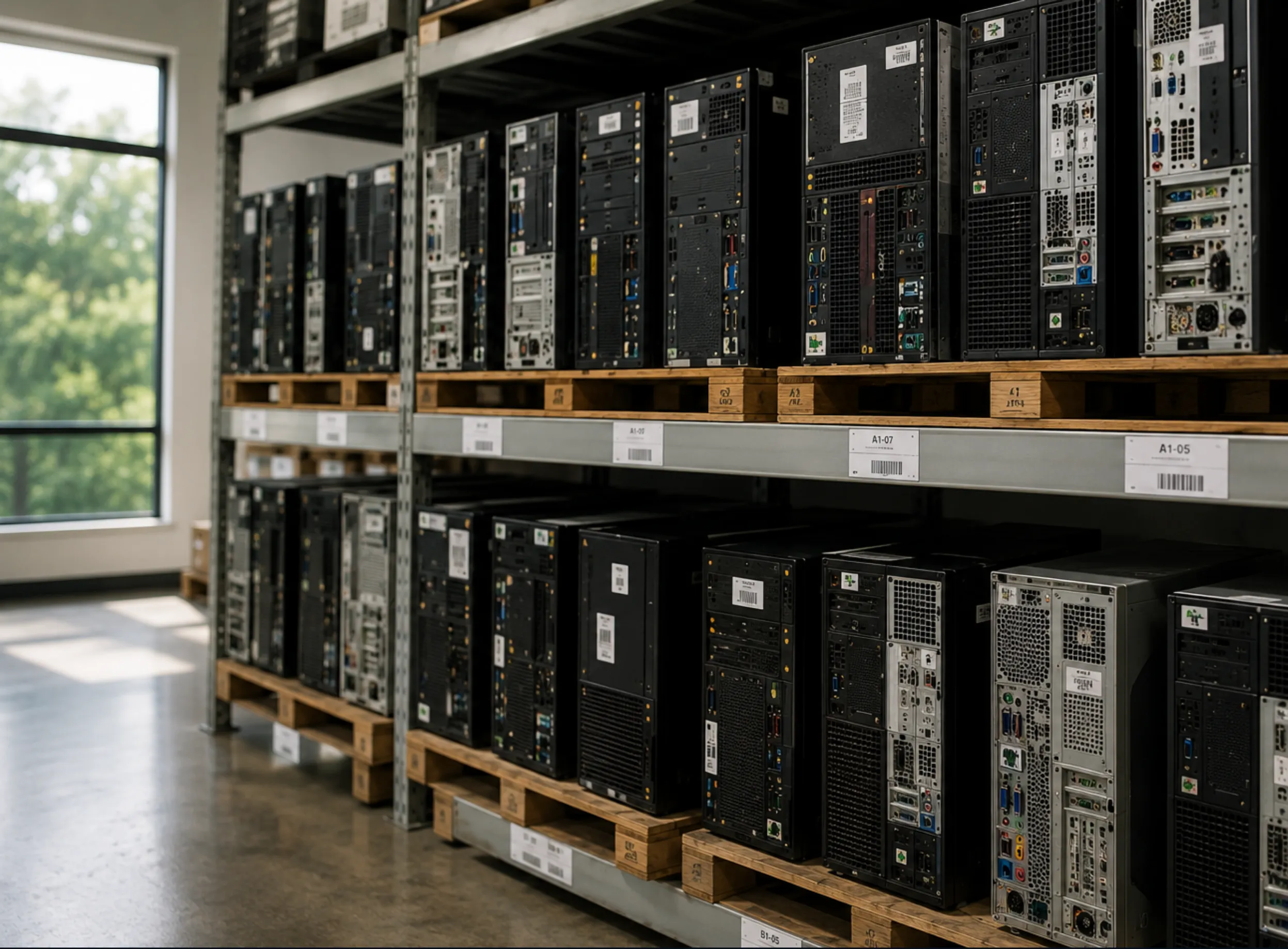
As organizations continue to upgrade their technology infrastructure, managing retired IT equipment has become an increasingly important part of modern business operations.
Companies regularly replace technology assets such as:
- Laptops
- Desktop computers
- Servers
- Storage devices
- Networking equipment
- Mobile devices
- Other electronic equipment
However, retiring technology is not simply about removing old devices from the workplace.
Every retired asset may still contain:
- Confidential company information
- Customer data
- Employee records
- Intellectual property
- Business documents
- Valuable recoverable materials
Without a proper process, organizations may face risks involving:
- Data exposure
- Compliance challenges
- Lost asset value
- Improper electronic waste disposal
This is where choosing the right IT Asset Disposition (ITAD) provider becomes critical.
A professional ITAD provider helps organizations securely manage retired technology by providing services such as:
- Secure equipment collection
- Asset tracking
- Data sanitization
- Assured Destruction
- Refurbishment
- Resale
- Responsible recycling
- Documentation and reporting
The right ITAD partner does more than remove old equipment.
They help organizations protect sensitive information, recover value from retired assets, support sustainability goals, and maintain accountability throughout the entire asset lifecycle.
This guide explains the key factors organizations should consider when choosing an ITAD provider.
What Is an ITAD Provider?
An IT Asset Disposition (ITAD) provider specializes in managing technology assets at the end of their useful life.
Instead of treating retired equipment as waste, ITAD providers evaluate each asset to determine the most secure and valuable next step.
A professional ITAD process may include:
Secure Collection
Removing retired equipment from company locations while maintaining proper tracking and accountability.
Asset Inventory and Evaluation
Recording important information such as:
- Device type
- Serial numbers
- Asset tags
- Condition
- Specifications
- Potential recovery value
Data Sanitization
Securely removing sensitive information through approved methods such as:
- Data wiping
- Cryptographic erase
- Physical destruction when required
Asset Recovery
Identifying opportunities for:
- Redeployment
- Refurbishment
- Resale
Responsible Recycling
Processing equipment that cannot be reused through proper electronic waste recycling channels.
Assured Destruction
Providing permanent destruction solutions for assets that require the highest level of data protection.
Why Choosing the Right ITAD Provider Matters
Many organizations underestimate the risks associated with retired technology.
Once equipment leaves daily business operations, companies still remain responsible for ensuring that sensitive information is properly protected.
A poorly managed ITAD process can create several challenges.
Data Security Risks
Retired devices may still contain sensitive information even after they are removed from employee use.
Examples include:
- Customer databases
- Financial records
- Employee information
- Passwords
- Internal communications
- Intellectual property
Without proper data sanitization, information may remain accessible.
Compliance Risks
Organizations are expected to protect sensitive information throughout its lifecycle.
A reliable ITAD provider helps companies maintain proper documentation and demonstrate that retired assets were handled responsibly.
This is especially important for industries that manage large amounts of confidential information, including:
- Financial services
- Healthcare organizations
- Government agencies
- BPO companies
- Large enterprises
Financial Loss From Poor Asset Management
Retired IT equipment may still have value.
A company that sends all equipment directly to disposal may miss opportunities for:
- Refurbishment
- Resale
- Redeployment
- Component recovery
A strong ITAD provider evaluates assets individually to maximize remaining value.
Environmental Concerns
Electronic equipment contains valuable materials that can often be recovered.
Improper disposal can contribute to:
- Increased electronic waste
- Loss of recoverable resources
- Environmental impact
A responsible ITAD provider prioritizes reuse and recovery before recycling whenever possible.
Key Factors When Choosing an ITAD Provider
Not all ITAD companies provide the same level of security, transparency, and service quality.
Organizations should carefully evaluate potential providers before selecting a long-term partner.
The following factors are important when choosing an ITAD provider.
1. Data Security Capabilities
Data security should be one of the most important considerations when selecting an ITAD partner.
Retired computers, servers, and storage devices may still contain sensitive information long after they are removed from active use.
A qualified ITAD provider should have clear processes for:
- Secure data wiping
- Data verification
- Storage device handling
- Physical destruction when required
- Documentation of completed services
The provider should be able to explain exactly how data is protected from collection through final disposition.
Questions to Ask About Data Security
Before choosing an ITAD provider, organizations should ask:
- What data sanitization methods do you use?
- Do you follow recognized industry standards?
- Can you provide data sanitization certificates?
- How do you handle failed storage devices?
- Do you offer Assured Destruction when required?
A provider that cannot clearly explain its data security process may not provide the level of protection an organization needs.
2. Chain of Custody and Asset Tracking
Once IT equipment leaves an organization's facility, maintaining visibility becomes one of the most important parts of the ITAD process.
A professional ITAD provider should maintain a clear chain of custody that tracks assets from collection until final disposition.
Chain of custody provides accountability by documenting:
- When assets were collected
- Where equipment was transported
- Who handled the assets
- When processing occurred
- What final outcome was reached
This process ensures organizations can verify that retired equipment was handled securely throughout its entire journey.
Why Chain of Custody Matters
Without proper tracking, organizations may lose visibility over retired assets.
This can create questions such as:
- Where did our equipment go?
- Who had access to the devices?
- Was sensitive data removed?
- Were assets properly recycled or destroyed?
- Can we prove what happened to our retired equipment?
A strong ITAD provider should provide transparency at every stage of the process.
Proper asset tracking supports:
- Internal audits
- Compliance requirements
- Security investigations
- Corporate governance
- Customer assurance
For organizations managing large numbers of devices, asset tracking is especially important because hundreds or thousands of retired assets may move through the disposition process.
3. Range of ITAD Services Offered
A reliable ITAD provider should offer more than basic equipment removal.
Technology assets follow different paths depending on their condition, security requirements, and remaining value.
A complete IT Asset Disposition program should include multiple services to manage every possible outcome.
Secure Collection and Reverse Logistics
The ITAD process begins when equipment is removed from an organization's location.
A professional provider should support secure collection through:
- Scheduled pickups
- Proper equipment handling
- Trained personnel
- Secure transportation
- Asset documentation
Reverse logistics ensures that retired technology moves safely from the workplace to the processing facility.
Data Sanitization Services
Before any equipment is reused, resold, recycled, or destroyed, sensitive information must be securely removed.
A qualified ITAD provider should offer:
- Data wiping
- Storage media sanitization
- Verification reports
- Data destruction documentation
The correct method depends on factors such as:
- Device condition
- Data classification
- Security requirements
- Business policies
Refurbishment Services
Many retired IT assets still have useful life remaining.
A capable ITAD provider should evaluate whether equipment can be restored through:
- Testing
- Cleaning
- Repairs
- Component replacement
- Software preparation
- Quality checks
Refurbishment allows organizations to extend equipment lifecycles while reducing unnecessary waste.
Resale and Asset Recovery
Some retired equipment may still have market value.
An experienced ITAD provider can help organizations recover financial value through resale opportunities.
Assets that may retain value include:
- Recent-generation laptops
- Enterprise servers
- Networking equipment
- Premium computing devices
Asset recovery helps organizations offset technology refresh costs while supporting a more sustainable approach to IT management.
Responsible Recycling
Not every retired device can be reused.
Equipment that is damaged, outdated, or economically impractical to refurbish should be processed through responsible electronic waste recycling channels.
A professional ITAD provider should ensure that:
- Materials are recovered properly
- Electronic waste is handled responsibly
- Environmental requirements are followed
- Disposal is minimized wherever possible
Assured Destruction Services
Some technology assets require permanent destruction due to security requirements.
Assured Destruction provides organizations with confidence that sensitive information stored on physical media is permanently eliminated.
This may be required for:
- Failed hard drives
- Damaged storage devices
- Highly confidential information
- Assets that cannot be reused
Methods may include:
- Hard drive shredding
- Crushing
- Physical destruction of storage media
- Controlled destruction processes
A responsible ITAD provider should only recommend destruction when necessary and should provide proper documentation confirming completion.
Why a Complete ITAD Service Offering Matters
Working with multiple vendors for collection, data destruction, recycling, and reporting can create unnecessary complexity.
A full-service ITAD provider simplifies the process by providing one controlled workflow.
Benefits include:
- Better accountability
- Easier reporting
- Reduced administrative effort
- Improved security management
- Consistent processing standards
A complete ITAD solution allows organizations to manage retired technology through a single trusted partner.
4. Refurbishment and Asset Recovery Capabilities
A strong ITAD provider should look beyond disposal.
Many organizations make the mistake of viewing retired technology as having no remaining value.
In reality, many devices can continue serving a useful purpose after their original role has ended.
A capable provider should evaluate whether assets can be:
- Redeployed internally
- Refurbished
- Resold
- Used for parts recovery
Benefits of Asset Recovery
Effective asset recovery allows organizations to:
Recover Financial Value
Reusable equipment may generate returns through resale or redeployment.
Reduce Electronic Waste
Keeping technology in use longer reduces unnecessary disposal.
Extend Product Lifecycles
Refurbished equipment can continue supporting users and organizations.
Support Sustainability Goals
Asset recovery supports circular economy principles by keeping products and materials in use.
5. Environmental Responsibility
Sustainability has become an important consideration when selecting an ITAD provider.
Organizations are increasingly looking for partners that can help reduce environmental impact while maintaining strong security practices.
A responsible ITAD provider should demonstrate proper environmental management throughout the disposition process.
Questions to Ask About Environmental Practices
Organizations should ask:
- How do you handle electronic waste?
- Do you prioritize reuse before recycling?
- How are recovered materials processed?
- Are recycling activities documented?
- What happens to equipment that cannot be refurbished?
A strong ITAD strategy follows a hierarchy:
- Redeploy when possible
- Refurbish when practical
- Resell valuable assets
- Recover usable components
- Recycle responsibly
- Dispose only when necessary
This approach helps organizations maximize asset value while reducing environmental impact.
6. Reporting and Documentation
Documentation is one of the most important elements of a professional IT Asset Disposition (ITAD) program.
A reliable ITAD provider should not only process retired equipment but also provide clear records showing what happened to each asset.
Proper documentation gives organizations visibility, accountability, and confidence throughout the entire disposition process.
Types of ITAD Documentation Organizations Should Expect
A professional ITAD provider may provide several types of reports depending on the services performed.
Asset Disposition Reports
Asset disposition reports provide details about equipment that has been processed.
These reports may include:
- Asset identification details
- Device information
- Quantity processed
- Final disposition outcome
Final outcomes may include:
- Redeployed
- Refurbished
- Resold
- Recycled
- Destroyed
These records help organizations maintain accurate asset inventories.
Data Sanitization Certificates
When devices are reused, refurbished, or resold, organizations should receive confirmation that sensitive information has been securely removed.
Data sanitization certificates may include:
- Devices processed
- Sanitization method used
- Completion date
- Verification results
These documents help demonstrate that data protection procedures were followed.
Certificates of Destruction
For assets requiring permanent destruction, organizations should receive a Certificate of Destruction.
A Certificate of Destruction may confirm:
- Assets destroyed
- Destruction method
- Date of completion
- Processing confirmation
This documentation provides evidence that sensitive storage media was securely destroyed.
Why ITAD Documentation Matters
Proper documentation supports organizations in several ways.
Supports Compliance Requirements
Companies may need evidence that sensitive information and electronic assets were handled responsibly.
Helps With Internal Audits
Clear records allow organizations to verify that retired equipment followed approved procedures.
Improves Corporate Governance
Documentation creates accountability and demonstrates responsible asset management.
Supports Sustainability Reporting
Organizations tracking environmental initiatives can measure:
- Equipment reused
- Materials recycled
- Waste avoided
7. Industry Experience and Expertise
Experience is another important factor when selecting an ITAD provider.
Different industries have different requirements when handling retired technology.
A provider experienced with your industry will better understand:
- Data security expectations
- Compliance considerations
- Asset volumes
- Reporting requirements
Industries That Commonly Require Professional ITAD Services
Banking and Financial Services
Financial organizations manage highly sensitive information, including:
- Customer records
- Transaction information
- Financial documents
These organizations often require strict data security controls and detailed reporting.
Healthcare Organizations
Healthcare companies manage sensitive personal information that requires careful protection.
Retired equipment may contain:
- Patient information
- Medical records
- Internal documents
Secure ITAD practices help reduce data exposure risks.
Business Process Outsourcing (BPO) Companies
BPO organizations often manage technology assets containing client information.
They may require:
- Large-scale processing capability
- Strong chain of custody
- Secure data sanitization
- Detailed documentation
Government Organizations
Government agencies may handle confidential information requiring controlled asset management processes.
Large Enterprises
Large organizations often manage thousands of technology assets across multiple locations.
They require ITAD providers capable of supporting:
- Complex logistics
- High asset volumes
- Consistent reporting
- Scalable processing
Questions to Ask About ITAD Experience
Before selecting a provider, organizations should ask:
- Have you worked with companies similar to ours?
- Can you manage our expected equipment volume?
- Do you understand our industry's security requirements?
- Can you provide examples of previous projects?
- How do you handle large technology refresh programs?
A provider with relevant experience is more likely to deliver a smooth and secure ITAD process.
8. Security Standards and Certifications
Organizations should consider whether an ITAD provider follows recognized security and environmental standards.
Standards help demonstrate that processes are structured, repeatable, and designed to protect sensitive information.
Important references may include:
NIST Special Publication 800-88
The National Institute of Standards and Technology (NIST) provides guidelines for media sanitization.
These guidelines help organizations determine appropriate methods for securely removing data from storage devices.
ISO/IEC 27001
ISO/IEC 27001 focuses on information security management systems.
Alignment with this standard demonstrates a commitment to structured information security practices.
ISO/IEC 21964
ISO/IEC 21964 provides guidance related to the destruction of data carriers.
This is particularly relevant for organizations requiring secure destruction processes.
Why Standards Matter When Choosing an ITAD Provider
Standards and certifications are not the only indicators of quality, but they can help organizations evaluate whether a provider has established processes.
A professional provider should be able to explain:
- How data is protected
- How assets are tracked
- How destruction is performed
- How documentation is created
Transparency is an important part of selecting the right ITAD partner.
9. Scalability and Logistics Capability
Organizations should choose an ITAD provider that can support both current requirements and future growth.
Technology refresh projects can involve:
- Dozens of devices
- Hundreds of laptops
- Thousands of enterprise assets
- Multiple office locations
A provider should have the ability to manage different project sizes efficiently.
Important Factors to Consider
Organizations should evaluate:
Collection Capacity
Can the provider support scheduled pickups and large equipment volumes?
Geographic Coverage
Can they support your business locations?
Processing Capability
Can they handle:
- Data sanitization
- Testing
- Refurbishment
- Recycling
- Assured Destruction
Reporting Capability
Can they provide clear records regardless of project size?
10. Transparency and Communication
A successful ITAD partnership depends on trust and communication.
A reliable provider should clearly explain:
- What happens after collection
- How assets are processed
- How data is protected
- What documentation is provided
- What happens to equipment after evaluation
Organizations should be cautious of providers that simply collect equipment without explaining the next steps.
Transparency helps companies maintain confidence throughout the entire IT asset lifecycle.
Questions to Ask Before Selecting an ITAD Provider
Before entering an agreement, organizations should ask:
Data Security
- How do you protect sensitive information?
- What data sanitization methods do you use?
- Do you provide destruction certificates?
Asset Management
- How are assets tracked?
- Can you provide disposition reports?
- How do you maintain chain of custody?
Sustainability
- What happens to equipment that cannot be reused?
- Do you prioritize refurbishment and recycling?
Service Capability
- Can you manage logistics?
- Do you provide refurbishment and resale services?
- Do you offer Assured Destruction when required?
Common Mistakes When Choosing an ITAD Provider
Selecting an ITAD provider is an important decision that affects an organization's data security, compliance position, financial recovery, and sustainability efforts.
However, many companies make mistakes when evaluating potential providers.
Understanding these common mistakes can help organizations choose a partner that provides real long-term value.
Mistake 1: Choosing an ITAD Provider Based Only on Price
Cost is an important consideration, but it should not be the only deciding factor.
The cheapest provider may not always provide the level of security, documentation, or environmental responsibility required.
A low-cost solution may create additional risks if the provider does not have proper processes for:
- Data sanitization
- Asset tracking
- Chain of custody
- Responsible recycling
- Documentation
The goal of ITAD is not simply to remove equipment at the lowest cost.
The goal is to protect information, recover value, and manage retired assets responsibly.
Mistake 2: Treating ITAD as Simple Equipment Disposal
Some organizations view ITAD as a way to get rid of old technology.
However, professional IT Asset Disposition is much more than disposal.
A complete ITAD process includes:
- Data protection
- Asset evaluation
- Value recovery
- Sustainability management
- Compliance documentation
A good ITAD provider helps organizations determine the best outcome for each asset rather than sending everything directly to recycling.
Mistake 3: Ignoring Data Security Processes
One of the biggest risks associated with retired IT equipment is leftover data.
Organizations should never assume that old devices are automatically safe.
A professional ITAD provider should have clear procedures for:
- Secure data wiping
- Data verification
- Storage media handling
- Assured Destruction when required
Companies should always understand how their data is protected after equipment leaves their facility.
Mistake 4: Failing to Request Documentation
Without proper documentation, organizations may struggle to prove that retired equipment was handled correctly.
A reliable ITAD provider should provide records such as:
- Asset disposition reports
- Data sanitization certificates
- Certificates of Destruction
- Recycling documentation
These records provide evidence of responsible processing.
Mistake 5: Destroying All Equipment Without Evaluation
While Assured Destruction is an important security option, not every retired device requires physical destruction.
Automatically destroying all equipment may result in lost opportunities for:
- Asset recovery
- Refurbishment
- Resale
- Redeployment
A better approach is evaluating each asset individually.
For example:
A working laptop may be securely wiped, refurbished, and reused.
A failed hard drive containing confidential information may require physical destruction.
The right ITAD strategy balances security, value recovery, and sustainability.
Mistake 6: Not Considering Environmental Practices
Some organizations focus only on data security and overlook environmental responsibility.
A responsible ITAD provider should have processes for:
- Equipment reuse
- Refurbishment
- Responsible recycling
- Material recovery
Electronic equipment contains valuable resources that should be recovered whenever possible.
Choosing a provider that supports a circular economy approach helps organizations reduce unnecessary electronic waste.
A Simple Checklist for Selecting an ITAD Provider
Before choosing an ITAD partner, organizations should confirm that the provider offers:
- Secure equipment collection
- Clear chain of custody procedures
- Asset tracking and inventory management
- Professional data sanitization
- Assured Destruction services when required
- Refurbishment capabilities
- Resale and asset recovery options
- Responsible electronic waste recycling
- Detailed reporting and documentation
- Experience with similar organizations
- Scalable logistics capabilities
- Transparent communication
The Role of ITAD in Long-Term Technology Management
ITAD should not be viewed as a one-time activity that happens only when equipment becomes obsolete.
A strong ITAD program should be part of the organization's overall technology lifecycle strategy.
The complete technology lifecycle includes:
- Planning and procurement
- Deployment
- Daily usage
- Maintenance and support
- Technology refresh planning
- IT Asset Disposition
By including ITAD from the beginning, organizations can better control:
- Technology costs
- Data security risks
- Asset value recovery
- Sustainability outcomes
Why ITAD Should Be Planned Before Equipment Retirement
Many organizations wait until old equipment is already sitting in storage before deciding what to do with it.
This approach can create problems such as:
- Reduced resale value
- Missing asset information
- Increased security risks
- Difficulty tracking devices
A better approach is to include ITAD planning during technology refresh projects.
Organizations should consider:
- How equipment will be collected
- How data will be removed
- Which assets can be reused
- Which assets require destruction
- How results will be documented
Early planning creates a smoother and more secure process.
How Envirocycle Can Help Organizations With ITAD
Choosing the right ITAD provider is about finding a partner that can manage retired technology securely while helping organizations recover value and meet sustainability goals.
Envirocycle provides organizations with a structured IT Asset Disposition solution designed to manage the complete lifecycle of retired electronic assets.
Through professional ITAD services, Envirocycle helps businesses with:
Secure IT Equipment Collection
Envirocycle helps organizations safely remove retired technology from their facilities while maintaining proper handling and accountability.
This includes support for:
- Corporate laptop disposal
- Computer equipment collection
- Server and networking equipment recovery
- Electronic asset transportation
Data Sanitization and Assured Destruction
Protecting sensitive information is one of the most important parts of ITAD.
Envirocycle helps organizations securely manage data-bearing devices through appropriate data protection processes.
Depending on asset condition and security requirements, solutions may include:
- Secure data wiping
- Data sanitization documentation
- Assured Destruction for storage devices requiring permanent elimination
Asset Recovery and Value Maximization
Instead of treating retired equipment as waste, Envirocycle evaluates opportunities to recover value.
Suitable assets may be:
- Refurbished
- Redeployed
- Recovered for resale
- Processed for responsible recycling
This approach helps organizations maximize the remaining value of their technology investments.
Responsible Electronic Waste Recycling
For equipment that cannot be reused, Envirocycle supports responsible recycling practices.
Through proper processing, valuable materials can be recovered while reducing unnecessary electronic waste.
Documentation and Reporting
Envirocycle helps organizations maintain visibility over their retired assets by providing appropriate documentation throughout the ITAD process.
Reports may include information related to:
- Asset processing
- Final disposition
- Data handling
- Recycling outcomes
This gives organizations confidence that their retired technology was managed responsibly.
Conclusion
Choosing the right ITAD provider is an important decision that affects more than just the removal of old technology.
Retired IT equipment can create significant risks if it is not handled properly, but it can also provide valuable opportunities when managed through a structured IT Asset Disposition process.
The right ITAD partner should help organizations:
- Protect sensitive information
- Maintain chain of custody
- Securely sanitize data
- Recover value from retired assets
- Support sustainability initiatives
- Maintain proper documentation
A professional ITAD provider does not simply take old equipment away.
They provide a complete lifecycle solution that ensures technology assets are handled securely, responsibly, and efficiently from collection through final disposition.
Organizations should evaluate ITAD providers based on:
- Data security capabilities
- Asset tracking processes
- Range of services
- Refurbishment and recovery opportunities
- Environmental responsibility
- Reporting and transparency
- Industry experience
The best ITAD provider is not necessarily the company offering the lowest price.
It is the partner that provides confidence that your retired technology, sensitive information, and environmental responsibilities are being managed correctly.
A strong ITAD strategy allows organizations to transform retired technology from a potential risk into an opportunity for security, value recovery, and sustainability.
Frequently Asked Questions
What should companies look for in an ITAD provider?
Companies should look for an ITAD provider that offers secure data handling, asset tracking, refurbishment options, responsible recycling, documentation, and experience managing technology retirement projects.
Is ITAD only necessary for large companies?
No. Organizations of all sizes can benefit from IT Asset Disposition services.
Small businesses may have fewer devices, but their retired laptops, computers, and storage devices can still contain sensitive information that requires proper handling.
Why is data security important when choosing an ITAD provider?
Retired devices may still contain confidential information even after they are removed from daily operations.
A qualified ITAD provider helps ensure that data is securely removed through methods such as data wiping or Assured Destruction when required.
Should companies choose the cheapest ITAD provider?
Not necessarily.
The lowest-cost provider may not always provide the security controls, documentation, or environmental practices needed to protect an organization.
Companies should consider overall value, including security, compliance, asset recovery, and sustainability.
What documentation should an ITAD provider provide?
A professional ITAD provider may provide documentation such as:
- Asset disposition reports
- Data sanitization certificates
- Certificates of Destruction
- Recycling records
These documents help organizations demonstrate responsible handling of retired technology.
What happens to IT equipment after it is collected by an ITAD provider?
After collection, equipment is typically:
- Inventoried and tracked
- Evaluated for condition and value
- Data sanitized or securely destroyed
- Refurbished, resold, recycled, or processed through Assured Destruction when required
- Documented through final reports
The final outcome depends on the condition of the equipment and the organization's security requirements.
Why is Assured Destruction important in ITAD?
Assured Destruction provides organizations with confidence that sensitive information stored on physical media is permanently eliminated.
It is commonly used for:
- Failed storage devices
- Highly sensitive information
- Devices that cannot be reused
- Assets requiring permanent disposal